Closing a chapter here with Blogger. It was a great platform and it helped me get started blogging. However, I'm looking to move past just blogging and the limited customization ended up being the reason I've decided to take my talents to a self-hosted platform!
So for now, you can find all the latest, greatest and hilarious blog posts at daizbiz.com!
But stay tuned as I look to build out other pages and content to continue to keep folks entertained!
Saturday, February 10, 2018

Race Report: Surf City Half Marathon
Great race and just slightly missed a PR. And by slightly, I mean 30 seconds! It was a good race to come back to 2 years later and see that while I'm not better, I'm not exactly worse. And given that I was running this one a bit heavier, it's definitely good news.
Race Details:
Huntington Beach, California
Run: 13.1mi, loop
Race Summary:
I was definitely nervous for this race. It's the only road running race that I've repeated and so there was a sense of doubt in my mind that I couldn't replicate my PR performance from 2016. I had to take melatonin to calm myself down after my carb loading dinner. But I got to sleep and was well rested for this race. I had my standard race breakfast, got to a toilet and then even the starting line with ease.
After the emotion of the star spangled banner, the gun went off and there I went. This race was one of those where you set your own starting position. You don't submit a time and get placed in a wave. You just show up and start where you feel you should be. That unfortunately leaves many slow runners at the front as they likely don't know that your time is based on when your chip crosses the start and not when you start relative to the gun. So early on, I was weaving through some people, but I made sure not to do too much of it. A director at my company who runs sub 3 hour marathons had mentioned to me that weaving through the crowds eats away at your energy and likely isn't worth it. So try to find a good line and hold your pace. Definitely some great advice!
Because really, by mile 2, most of the slow folks have fallen back and the course thins out. And it was really easy to run my own race. Everything was going really well too. I had a plan to start taking Honey Stinger gels at mile 4 and then every 2 miles thereafter. That went well and I was really able to keep my cadence high and my legs felt great. In fact, I didn't have any challenges on "the hill" at mile 4 and wasn't stopping to walk or jog thru aid stations. I grabbed my water as I ran and went.
Eventually though, the fast start and the blazing sun seemed to catch up to me. By the turn around on PCH at mile 8, I had to mentally push myself to keep up the cadence. It started to get real tough. By mile 10, I had slowed enough to make a difference and that slowing held until mile 12. Now granted, mile 11-12 is right about where the other "hill" sits. And I definitely didn't power thru this one like I did the first one, but I did "run" up it.
By the end, I really had to push my mind to keep me going. Then I saw the mile 12 marker and started to drop the hammer. I mean it wasn't exactly "dropping the hammer" per se, but relative to the last 2 miles, it was much faster and it felt painful too. But I pushed to the finish and even the official race picture of me running there is hilarious!
All in all, a good race despite missing the PR. I've built a good base and have a good idea of my training progressing in a positive direction after a lackluster 2016 and 2017. Hopefully that bodes well for Oceanside and then Chicago!
2016 vs. 2018 Comparison:


Map and Stats Plot:


Heart Rate Zones:

Race Charts:
Course Reported Finish:


Race Details:
Huntington Beach, California
Run: 13.1mi, loop
Race Summary:
I was definitely nervous for this race. It's the only road running race that I've repeated and so there was a sense of doubt in my mind that I couldn't replicate my PR performance from 2016. I had to take melatonin to calm myself down after my carb loading dinner. But I got to sleep and was well rested for this race. I had my standard race breakfast, got to a toilet and then even the starting line with ease.
After the emotion of the star spangled banner, the gun went off and there I went. This race was one of those where you set your own starting position. You don't submit a time and get placed in a wave. You just show up and start where you feel you should be. That unfortunately leaves many slow runners at the front as they likely don't know that your time is based on when your chip crosses the start and not when you start relative to the gun. So early on, I was weaving through some people, but I made sure not to do too much of it. A director at my company who runs sub 3 hour marathons had mentioned to me that weaving through the crowds eats away at your energy and likely isn't worth it. So try to find a good line and hold your pace. Definitely some great advice!
Because really, by mile 2, most of the slow folks have fallen back and the course thins out. And it was really easy to run my own race. Everything was going really well too. I had a plan to start taking Honey Stinger gels at mile 4 and then every 2 miles thereafter. That went well and I was really able to keep my cadence high and my legs felt great. In fact, I didn't have any challenges on "the hill" at mile 4 and wasn't stopping to walk or jog thru aid stations. I grabbed my water as I ran and went.
Eventually though, the fast start and the blazing sun seemed to catch up to me. By the turn around on PCH at mile 8, I had to mentally push myself to keep up the cadence. It started to get real tough. By mile 10, I had slowed enough to make a difference and that slowing held until mile 12. Now granted, mile 11-12 is right about where the other "hill" sits. And I definitely didn't power thru this one like I did the first one, but I did "run" up it.
By the end, I really had to push my mind to keep me going. Then I saw the mile 12 marker and started to drop the hammer. I mean it wasn't exactly "dropping the hammer" per se, but relative to the last 2 miles, it was much faster and it felt painful too. But I pushed to the finish and even the official race picture of me running there is hilarious!
All in all, a good race despite missing the PR. I've built a good base and have a good idea of my training progressing in a positive direction after a lackluster 2016 and 2017. Hopefully that bodes well for Oceanside and then Chicago!
2016 vs. 2018 Comparison:

When there's 30sec in between finish times, there's not usually a huge difference between the details.
Some notable differences were:
-Calorie burn: fewer calories burned in 2016, likely due to weighing less back then
-Moving time vs. Elapsed time: seems that I must've walked through some aid stations in 2016
-HR: both avg and max were higher in 2016 which is strange, but it's possible since your HR decreases with age, at least by conventional theories
Looking at the split comparison, I was faster for 9 of the 13 splits in 2016. But the margin of difference is so small for miles 1-7 and it's crazy how close the race was up to mile 8, maybe even lump mile 9 in there. After that, there was clearly a struggle bus for miles 10-12. It's clear I was able to pick it up at some point in mile 12 and push to the finish, but that little gap there for 2+ miles was just what I couldn't overcome.

Map and Stats Plot:


Ran hard for this one and the heart rate really shows it. Z4 and Z5 for all of the half except 2:10. That's pretty crazy! This one was definitely a Heart Attack Hustle!
Course Reported Finish:

Not a PR, but sooooooo close... :(
Run:

Nothing too insightful here on the summary. Max cadence of 240 is pretty off the charts, just as the best pace of 5:41. However, max means nothing as I likely held that for all of 5 seconds. The averages are more in line with what I was able to sustain. Cadence of 187 isn't too bad and I'll need to up that if I really wanna get to Boston. The 8:16 is really not great. That def needs to go down. Not sure how I get there though. Aye...

Peering into the mile by mile breakdown, my pace was really good up until about mile 7. Maybe even lump miles 8 and 9 into the good category. I mean sub 8:30 is pretty solid and right around the low 8s in the first 10K as well. But after mile 9, it just wasn't good. I somehow found that extra gear for the last 1.1 miles, but just too much ground to make up I think.
Pics:


The timeline of me passing this old dude in pictures... Why he was already ahead of me, I can't even... LOL


Pushing to the finish... Oh the struggle bus...

Finished!


Kiss the bling baby, hard earned


Surf City swag, including the California Dreamin medal! Plus Ellie and Amanda!


Post race noms at Crema Cafe in Seal Beach!
Sunday, January 7, 2018
2017 Year in Review
A little late to getting to this year's recap. I spent the holiday season spending time with family both in Vegas for Christmas and then Hawaii for New Years and my gramps' 95th birthday. It was great quality time well spent with loved ones, but it was also a very fat kid affair all around. I tried to mitigate that with daily 3 mile runs and a handful of gym workouts, but it did not counteract it all. So instead, I start the year at 190 lbs, 15 lbs from where I want to be and 5 lbs from where I normally am. Definitely not a good start...

Getting back to 2016, it appears that last year I was a bit brief with my assessment. Shame on me! I won't go as crazy as 2015, but definitely want to take a look at a now 3-year analysis of some major details. Let's start taking a look at the steps trends:

The month by month trends tell us a few things. I actually started off 2015 with the fewest amount of steps, but I really built up 2015 in prep for Wildflower Long Course and then went crazy high over the summer, in prep for Ironman Florida. In 2016, I was generally flat across the board except for October/November. That represents somewhat of a slow time during the summer and a quick ramp for the Honolulu Marathon. In 2017, I generally started higher than the previous 2 years, but I never exceed the pace of 2015 until October in prep for the NYC Marathon.
What this tells me is that I probably need to start the year off strong and then keep riding that momentum higher towards 2015 type levels in order to be in better shape. This is key if I really want to PR the Chicago Marathon and take my one shot at a Boston Qualifier. Obviously my work schedule will play a large part in all of this, but I'm hopeful I can drop some weight, pickup some speed/strength and get close. Having the EMR test data should help tremendously as well!

I threw in the year totals just to say one quick point: 600k more steps in 2015 than either of the last 2 years! What?!?!?! I mean that's a huge gap and speaks to all the training I did in 2015 and that is why I was in such better shape. With that knowledge, I hope to consciously take that into account and get in more steps (whether it be running or swimming, as cycling doesn't log any steps). Such a crazy gap tho! Never would have guessed based on the month-by-month comparison!
From a racing standpoint, 2016 was relatively light. I did a pair of bike rides with Amanda that didn't go as well. PR'ed my annual RB Tri but failed to hit my sub 1-hour goal by 20 sec. Got a 2nd place finish at Castaic Lake but missed first place by 10 sec. Did Malibu with strep throat and was slower but still under 3 hrs after pushing thru a dropped chain for the first time in a race. Had that super disappointing cancellation of the NOLA 70.3. And ended with a personal worst time at the NYC Marathon, all those bridges and gradual grade increases taken into consideration. All-in-all, 2016 was kind of a fail from a racing standpoint!
But as with any failure, it's best to learn from it and get better than sulk and cry about it. The step data helps, the EMR test gives me areas to improve upon, hopefully work allows me a better opportunity to train consistently, gotta seriously clean up the diet and just generally do better.
Looking ahead, I've set my sights on 2 major races. First, I'm looking to tackle Oceanside 70.3. Due to the crappy experience of NOLA 70.3, I'm disappointed by the Ironman brand and so Oceanside is my only 70.3 as I had signed up way in advance. This is definitely my first half of the year "A" race. Second, I'm looking at the Chicago Marathon as my last half of the year "A" race. This will be my 2nd Abbott World Marathon Majors race. It's supposedly a flat and fast one so I'm hoping that I can get my training up to par and give Boston my best shot. It's a crazy and unlikely goal as I've never been close to a BQ time, but it's worth a shot with nothing else on the calendar.
We'll see how things go. More races will definitely be added to the calendar. I mean I need to keep up my Honey Stinger and Team Nuun ambassadorships so I can get them again next year. Plus, I just really love racing in general. Training not so much, but racing definitely.
With that said, 2017 be gone and 2018 here we go!!!


(photo credit: http://fairytailfanon.wikia.com/wiki/File:Fail_Meme.jpg)
Getting back to 2016, it appears that last year I was a bit brief with my assessment. Shame on me! I won't go as crazy as 2015, but definitely want to take a look at a now 3-year analysis of some major details. Let's start taking a look at the steps trends:
The month by month trends tell us a few things. I actually started off 2015 with the fewest amount of steps, but I really built up 2015 in prep for Wildflower Long Course and then went crazy high over the summer, in prep for Ironman Florida. In 2016, I was generally flat across the board except for October/November. That represents somewhat of a slow time during the summer and a quick ramp for the Honolulu Marathon. In 2017, I generally started higher than the previous 2 years, but I never exceed the pace of 2015 until October in prep for the NYC Marathon.
What this tells me is that I probably need to start the year off strong and then keep riding that momentum higher towards 2015 type levels in order to be in better shape. This is key if I really want to PR the Chicago Marathon and take my one shot at a Boston Qualifier. Obviously my work schedule will play a large part in all of this, but I'm hopeful I can drop some weight, pickup some speed/strength and get close. Having the EMR test data should help tremendously as well!
I threw in the year totals just to say one quick point: 600k more steps in 2015 than either of the last 2 years! What?!?!?! I mean that's a huge gap and speaks to all the training I did in 2015 and that is why I was in such better shape. With that knowledge, I hope to consciously take that into account and get in more steps (whether it be running or swimming, as cycling doesn't log any steps). Such a crazy gap tho! Never would have guessed based on the month-by-month comparison!
From a racing standpoint, 2016 was relatively light. I did a pair of bike rides with Amanda that didn't go as well. PR'ed my annual RB Tri but failed to hit my sub 1-hour goal by 20 sec. Got a 2nd place finish at Castaic Lake but missed first place by 10 sec. Did Malibu with strep throat and was slower but still under 3 hrs after pushing thru a dropped chain for the first time in a race. Had that super disappointing cancellation of the NOLA 70.3. And ended with a personal worst time at the NYC Marathon, all those bridges and gradual grade increases taken into consideration. All-in-all, 2016 was kind of a fail from a racing standpoint!
But as with any failure, it's best to learn from it and get better than sulk and cry about it. The step data helps, the EMR test gives me areas to improve upon, hopefully work allows me a better opportunity to train consistently, gotta seriously clean up the diet and just generally do better.
Looking ahead, I've set my sights on 2 major races. First, I'm looking to tackle Oceanside 70.3. Due to the crappy experience of NOLA 70.3, I'm disappointed by the Ironman brand and so Oceanside is my only 70.3 as I had signed up way in advance. This is definitely my first half of the year "A" race. Second, I'm looking at the Chicago Marathon as my last half of the year "A" race. This will be my 2nd Abbott World Marathon Majors race. It's supposedly a flat and fast one so I'm hoping that I can get my training up to par and give Boston my best shot. It's a crazy and unlikely goal as I've never been close to a BQ time, but it's worth a shot with nothing else on the calendar.
We'll see how things go. More races will definitely be added to the calendar. I mean I need to keep up my Honey Stinger and Team Nuun ambassadorships so I can get them again next year. Plus, I just really love racing in general. Training not so much, but racing definitely.
With that said, 2017 be gone and 2018 here we go!!!

(photo credit: https://www.centage.com/3-key-trends-for-cfos-2018/)
Monday, December 11, 2017
Getting Measured, And What It Means
Last week, I decided that I wanted to get my athletic performance measured and headed over to TriFit to meet with Jeff Rothschild. Through TriFit, Jeff offers several different tests, but the one I decided to take was the EMR test to measure both my VO2Max as well as my carb vs. fat burning chart. Let's just say that the results were very insightful!
Let's start with the obvious stuff: body composition. The short answer: you're fat, lose some weight HAHAHAHAHA.

I mean the first measurement was BMI. A simple and arcane measurement that takes into account mass vs. height. Almost anyone who has a decent amount of muscle mass will have a high BMI, which is the main issue with the measurement. I guess I should just be lucky that I didn't fall into the Obesity range. WIN!

The next measurement taken was Fat Mass. This was the real sad one. It's a measure of the amount of fat you're body is carrying. I have one of those "smart" scales at home that tells me I'm around 20%. Shows the value of commercial devices vs. medical grade devices. The medical grade device said I'm at 28.6%. WOW! That's pretty damn fat. Time to lose some weight buddy...

After that huge blow of bad news, I got some decent news. The device measured my Skeletal Muscle Mass or the amount of muscle you're carrying. So the good news is that all my bars are above the average for someone in my comparison group. That means I'm stronger than average and by a good amount. What's particularly hopeful for triathlon is that I'm above average in my torso (aka chest/back) and my legs. So the bigger body parts and the ones used for speed have the potential to impact my performance greatly. Other good news is that my muscle mass is fairly balanced, so I don't have a right or left side dependency. There's still hope yet!

The last big measurement was Energy Expenditure. Based on some of the above measurements, I should be eating about 1800-2000 Calories per day just to maintain normal activity. However, with about 1 hour of exercise, I can ramp up my Calorie consumption to the 2800-3000 range. Good to know if you're gonna be counting those calories.

Next came the really good athletic stuff.
Let's first start with the training zones. A lot of training plans reference the training zones you should be working in for different types of workouts. So whether it's low intensity, long distance mileage or high intensity/sprint work, this measurement laid out the exact Heart Rate ranges I should be working in. It also mapped out what my Calories/Hour looked like in those zones. So if I run for an hour at around 160bpm, then I'm looking at a solid 900 calories burned for that session.
Based on the measurements, I should be under 120bpm for most easy work. I wanna stay in the 150-160bpm range for long easy work. Sprint work needs to exceed 170bpm. And if I'm really trying to push the VO2Max, I need to be pushing 190bpm or even my max measured at 201bpm.


What it all means?
Well it can all be summarized down into the below plots. What you're looking at is a couple different things. On top, we're looking at my VO2Max for each of the discrete Heart Rate measurements on the right. On the bottom you're looking at my pace for those same Heart Rates. Lastly, on the left you're looking at my carb-to-fat usage, again in those rates.
The athletic engine stuff I've already covered. The only new thing would be the bottom chart which also shows my pace for the heart rates. So again, paces for working in the respective heart rate zones.
But the lines to pay attention to are the grey and yellow ones. Grey is the % of calories burned from carbs while Yellow is the same but for fat. This is where some really insightful information came in. So I guess in an elite athlete, the curves would be more dramatic such that you're using more carbs at higher heart rates. This is because carbs are a quick fuel source and your body should be using them. This is actually where my body has adapted. Because I don't have a high engine compared to elite athletes, my body has compensated for being more efficient in burning fat for fuel and keeping that pretty steady throughout my various heart rate zones. What it means is that I won't be great at going fast because I can't use quick source fuel, but I should be good at going slow for long distances.
That leads to the low end being about right. My body burns carbs and fat almost equally at the lower heart rate zones. This is great news for long distance endurance work. Basically, the reason I can run marathons with sub-optimal training and athletic prowess is because my body has adapted. If I run at those lower heart rates, I can use my natural fuel (aka my fat) to keep going without hitting the wall.

What it all means is that after losing some weight, I do really need to work on speed work but also speed + fueling with more calories. The speed work will help push the VO2Max and help build a bigger engine. Then in addition to that, I need to do that speed work with more calories for fuel. This way my body will get used to having more calories and trying to burn them. So as my VO2Max potentially goes up, my body can also become more efficient at burning calories.
So very educational session, lots of things to work on and hope for my athletic future. Now on to the eternal struggle of trying to lose weight! HA!


Let's start with the obvious stuff: body composition. The short answer: you're fat, lose some weight HAHAHAHAHA.

(photo credit: http://www.quickmeme.com/meme/37if)
I mean the first measurement was BMI. A simple and arcane measurement that takes into account mass vs. height. Almost anyone who has a decent amount of muscle mass will have a high BMI, which is the main issue with the measurement. I guess I should just be lucky that I didn't fall into the Obesity range. WIN!


Let's first start with the training zones. A lot of training plans reference the training zones you should be working in for different types of workouts. So whether it's low intensity, long distance mileage or high intensity/sprint work, this measurement laid out the exact Heart Rate ranges I should be working in. It also mapped out what my Calories/Hour looked like in those zones. So if I run for an hour at around 160bpm, then I'm looking at a solid 900 calories burned for that session.
Based on the measurements, I should be under 120bpm for most easy work. I wanna stay in the 150-160bpm range for long easy work. Sprint work needs to exceed 170bpm. And if I'm really trying to push the VO2Max, I need to be pushing 190bpm or even my max measured at 201bpm.

The next big measurement was the VO2Max itself. This one wasn't too great. VO2Max is basically a measurement of your athletic engine. It's how well your body takes in oxygen and maximizes it to become energy. My result of 49 is noted in the Excellent range. So I mean I'm better than the average joe in terms of my engine. However, you really want to be well above the Superior number to be an elite athlete, or even an elite Age Grouper. So there's a lot of work to be done there if that's where I want to get.
The bad news: there are really only 2 ways to increase VO2Max.
1) Do VO2Max work. This means things like hill climbs, hill sprints or sprinting mile repeats. Work where you're pushing yourself at the highest possible amount
2) Lose some weight. VO2Max does have some relation to weight, so every pound lost will have an effect on the measurement

Well it can all be summarized down into the below plots. What you're looking at is a couple different things. On top, we're looking at my VO2Max for each of the discrete Heart Rate measurements on the right. On the bottom you're looking at my pace for those same Heart Rates. Lastly, on the left you're looking at my carb-to-fat usage, again in those rates.
The athletic engine stuff I've already covered. The only new thing would be the bottom chart which also shows my pace for the heart rates. So again, paces for working in the respective heart rate zones.
But the lines to pay attention to are the grey and yellow ones. Grey is the % of calories burned from carbs while Yellow is the same but for fat. This is where some really insightful information came in. So I guess in an elite athlete, the curves would be more dramatic such that you're using more carbs at higher heart rates. This is because carbs are a quick fuel source and your body should be using them. This is actually where my body has adapted. Because I don't have a high engine compared to elite athletes, my body has compensated for being more efficient in burning fat for fuel and keeping that pretty steady throughout my various heart rate zones. What it means is that I won't be great at going fast because I can't use quick source fuel, but I should be good at going slow for long distances.
That leads to the low end being about right. My body burns carbs and fat almost equally at the lower heart rate zones. This is great news for long distance endurance work. Basically, the reason I can run marathons with sub-optimal training and athletic prowess is because my body has adapted. If I run at those lower heart rates, I can use my natural fuel (aka my fat) to keep going without hitting the wall.

What it all means is that after losing some weight, I do really need to work on speed work but also speed + fueling with more calories. The speed work will help push the VO2Max and help build a bigger engine. Then in addition to that, I need to do that speed work with more calories for fuel. This way my body will get used to having more calories and trying to burn them. So as my VO2Max potentially goes up, my body can also become more efficient at burning calories.
So very educational session, lots of things to work on and hope for my athletic future. Now on to the eternal struggle of trying to lose weight! HA!
Just some pics of me looking like Bane and running on the treadmill, trying not to die


Thursday, November 9, 2017
Race Report: NYC Marathon
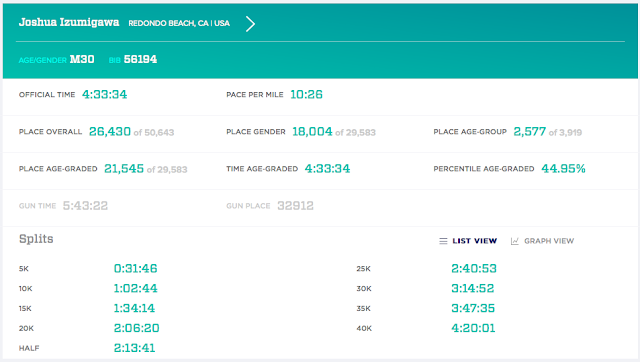
Well, at least I officially have a World Marathon Major race under my belt. Besides that and fundraising for a great cause, I think that's the only bright spots to this race. Sadly, I set my Personal Worst aka the Reverse PR, eclipsing my 2016 Honolulu Marathon by about 45sec. Safe to say, it wasn't a great day out on the course for me.
I'm glad it's the last race of my season (I've since decided to axe the HITS Palm Springs 70.3 idea) and I can take some stress/pressure of not training off. It'll be good to relax the body a bit, focus on strength, flexibility and maybe trying to lose some body fat. Who knows. It'll be thoughts to ponder for another post...
Race Details:
New York City, New York
Run: 26.2mi, point to point
Race Summary:
Before I breakdown my race, I wanna touch on something that kind of frustrated me. The logistics for getting to the start line of this race are pretty ridiculous. I joked that I had to take a car, a plane then a train, boat and bus just to walk to the starting line. Obviously, coming from across the country, it's a no brainer that I'd be flying here. But since the bus transportation option from Manhattan was sold out, I had to choose the Staten Island Ferry. And that was ferry terminal was such a mess race morning. So many people packed into that terminal and everyone cramming and pushing to get on the boat. Luckily I got a seat. But you get off the boat and then have to walk thru the food court and stand in another long line just to get on a bus to Fort Wadsworth. All in all, I left the hotel at 7am and didn't even get into the race waiting area until 10:35am. I joked with my bus buddy that it takes a marathon to get to the marathon start line. At least I had enough time to hit the potty and get to my corral before my wave start. Some other folks on the bus were not so lucky...
Those first 3 miles are really as advertised. I mean, we rode the Verrazano Bridge for the Bike Tour in May, but running up that bad boy was a rough way to start. Similar to the SF 2nd Half start, I focused on telling myself to go slow, don't kill your race right here, all the people passing you will get owned by you later. And as the story always goes, I definitely passed a lot of those people later in the race. So success there.
The next stretch of miles through Brooklyn and Queens were comfortable. I made sure not to push it too hard remembering that I wanted to run this race and not hit the wall. I was trying to negative split it to see if that would hurt less (spoiler alert, I'm not sure it did, but I felt better throughout the race). But coming off that first bridge and running through Brooklyn was really awesome because of the crowds. And this would be a theme throughout. The people of NY really lined the streets and cheered on thousands of random strangers. It's pretty amazing and uplighting to feel all that energy!
The next major stretch of note came at mile 15 on the Queensboro Bridge. That was the 2nd stretch of elevation via a bridge. That one actually felt painful. Again, I didn't walk and I'm proud of that, but it was definitely a slow trudge. After you get off that bridge though, it's nice to again have a giant crowd cheering and kinda giving you that mental pick me up to keep going and keep the momentum.
I kept it together for a couple more miles, but mile 19 was where I started walking thru aid stations. I hadn't hit the wall per se, but I knew that the real race was going to start and I felt like I needed a chance to get some energy. The last 10K is always where the battle is going to be both mentally, physically and in terms of finishing time. And it def was a battle. Particularly because the last hill into Central Park was killer. I was so hopeful that I could use my training, my negative splitting and all my will power to push thru the last 10-8K to a sub 4:30 time. That didn't happen. The hill was real and the pain and fatigue was even more real. I was trudging up it at a pace faster than many (likely those who passed me in the first miles), but I couldn't achieve the much faster splits that I wanted.
In what seemed like an eternity, I kept pushing up the hill, along the park and finally thru Central Park to the finish line! It was about 1.5 miles but it felt longer than the entire marathon. It literally felt like an eternity. Fatigue was setting in hard, I wanted to walk, the pains in my feet and knees just kept getting worse and worse. But finally I did it! I crossed the line, I grabbed my medal and tried to shove some pretzels, water and banana into my body as I waddled thru the finisher area. And despite knowing I set a personal worst, I still felt accomplished that I did this bucket list race!
A note about finishing a marathon and the moments after. You feel terrible. You're horribly sore. And then they make you walk forever to get all your post race things and get out to some place where you can get transportation home. It's terrible. They should definitely make it easier so athletes can choose to just get out and go rest somewhere. Or maybe that's why they offer a VIP area... Exit early... for a fee $$$
Oh a quick note about my fueling plan: I had a strategy and it worked! My plan was to eat a Honey Stinger gel about every 35-45 minutes and take the Salt Stick pills every 30 minutes. That plus keeping a heart rate in the 160s helped me avoid the wall! So I was definitely happy about that!
Map and Stats Plot:


Heart Rate Zones:

Race Charts:
Course Reported Finish:




I'm glad it's the last race of my season (I've since decided to axe the HITS Palm Springs 70.3 idea) and I can take some stress/pressure of not training off. It'll be good to relax the body a bit, focus on strength, flexibility and maybe trying to lose some body fat. Who knows. It'll be thoughts to ponder for another post...
Race Details:
New York City, New York
Run: 26.2mi, point to point
Race Summary:
Before I breakdown my race, I wanna touch on something that kind of frustrated me. The logistics for getting to the start line of this race are pretty ridiculous. I joked that I had to take a car, a plane then a train, boat and bus just to walk to the starting line. Obviously, coming from across the country, it's a no brainer that I'd be flying here. But since the bus transportation option from Manhattan was sold out, I had to choose the Staten Island Ferry. And that was ferry terminal was such a mess race morning. So many people packed into that terminal and everyone cramming and pushing to get on the boat. Luckily I got a seat. But you get off the boat and then have to walk thru the food court and stand in another long line just to get on a bus to Fort Wadsworth. All in all, I left the hotel at 7am and didn't even get into the race waiting area until 10:35am. I joked with my bus buddy that it takes a marathon to get to the marathon start line. At least I had enough time to hit the potty and get to my corral before my wave start. Some other folks on the bus were not so lucky...
Those first 3 miles are really as advertised. I mean, we rode the Verrazano Bridge for the Bike Tour in May, but running up that bad boy was a rough way to start. Similar to the SF 2nd Half start, I focused on telling myself to go slow, don't kill your race right here, all the people passing you will get owned by you later. And as the story always goes, I definitely passed a lot of those people later in the race. So success there.
The next stretch of miles through Brooklyn and Queens were comfortable. I made sure not to push it too hard remembering that I wanted to run this race and not hit the wall. I was trying to negative split it to see if that would hurt less (spoiler alert, I'm not sure it did, but I felt better throughout the race). But coming off that first bridge and running through Brooklyn was really awesome because of the crowds. And this would be a theme throughout. The people of NY really lined the streets and cheered on thousands of random strangers. It's pretty amazing and uplighting to feel all that energy!
The next major stretch of note came at mile 15 on the Queensboro Bridge. That was the 2nd stretch of elevation via a bridge. That one actually felt painful. Again, I didn't walk and I'm proud of that, but it was definitely a slow trudge. After you get off that bridge though, it's nice to again have a giant crowd cheering and kinda giving you that mental pick me up to keep going and keep the momentum.
I kept it together for a couple more miles, but mile 19 was where I started walking thru aid stations. I hadn't hit the wall per se, but I knew that the real race was going to start and I felt like I needed a chance to get some energy. The last 10K is always where the battle is going to be both mentally, physically and in terms of finishing time. And it def was a battle. Particularly because the last hill into Central Park was killer. I was so hopeful that I could use my training, my negative splitting and all my will power to push thru the last 10-8K to a sub 4:30 time. That didn't happen. The hill was real and the pain and fatigue was even more real. I was trudging up it at a pace faster than many (likely those who passed me in the first miles), but I couldn't achieve the much faster splits that I wanted.
In what seemed like an eternity, I kept pushing up the hill, along the park and finally thru Central Park to the finish line! It was about 1.5 miles but it felt longer than the entire marathon. It literally felt like an eternity. Fatigue was setting in hard, I wanted to walk, the pains in my feet and knees just kept getting worse and worse. But finally I did it! I crossed the line, I grabbed my medal and tried to shove some pretzels, water and banana into my body as I waddled thru the finisher area. And despite knowing I set a personal worst, I still felt accomplished that I did this bucket list race!
A note about finishing a marathon and the moments after. You feel terrible. You're horribly sore. And then they make you walk forever to get all your post race things and get out to some place where you can get transportation home. It's terrible. They should definitely make it easier so athletes can choose to just get out and go rest somewhere. Or maybe that's why they offer a VIP area... Exit early... for a fee $$$
Oh a quick note about my fueling plan: I had a strategy and it worked! My plan was to eat a Honey Stinger gel about every 35-45 minutes and take the Salt Stick pills every 30 minutes. That plus keeping a heart rate in the 160s helped me avoid the wall! So I was definitely happy about that!
Map and Stats Plot:


Heart Rate Zones:

The chart tells the story that I lived this marathon in Zone 4. In fact, I was pretty much only in Zone 5 for the very end where I tried my hardest to make a push to get under 4:30. That didn't happen... It's interesting that I was probably in Zone 3 for the uphill/downhill part of the Verrazano Bridge which is mile 0-3 of the race. I'd have to guess that was either a mistake or that my HR actually went down as I was going downhill. Very interesting...
Course Reported Finish:

Welp... There goes a personal worst aka the Reverse PR... I'm so awesome right? :(
Run:

Well the Garmin was all kinds of off and haywire, likely due to all the runners trying to ping satellites as well as various trouble areas for signals like the bridges and running between tons of high buildings. Alas, it shows the summary that my HR was high on average and my pace was slow on average. But the one thing it shows is that my actual moving time was 2 minutes faster than my finish. That's because there was a fire in some apartment building at Mile 18. So the race was literally stopped for 2+ minutes so that a fire truck could get to that building. Definitely lost some time and momentum there, but overall didn't change much... I guess it could've helped me avoid setting a new Reverse PR... LOL
Pics:

Obligatory Times Square photo

Zombie Times Square photo after the red eye flight


Various expo photos


Did a little bit of sight seeing on Saturday


Carb loading dinner!


Shots from the morning ferry ride

Therapy dogs right outside the race corrals


This race was packed! 51,000 runners!

Me telling the volunteer how to take a photo with my iPhone turned into hilarious candid

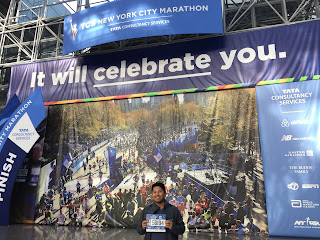
A good, normal photo at the finish line


Totally happy with pizza and beer post race :D

Eating all the donuts the next morning

Hanging with Angela and recapping our races and pain points the next day!

Views from the floor level at the CTF NY office! They're even better higher up!

Like this :D

A Medal Monday shot with the Brooklyn Bridge!
Subscribe to:
Posts (Atom)